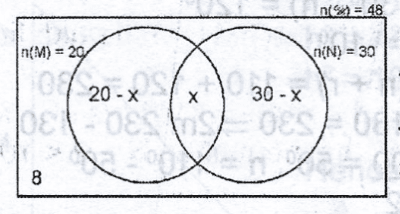
Concept:Use the set relation n(M∪N)=n(M)+n(N)−n(M∩N), because elements common to both sets are counted twice when the individual sizes are added.Explanation:Let n(M∩N)=x.Substitute the given values:40=20+30−x.So 40=50−x.Hence x=50−40=10.Thus 10 elements belong to both M and N.
Answer:n(M∩N)=10.So the given options do not contain the correct answer as printed.Option D would correspond to n((M∩N)′)=38, not to n(M∩N).