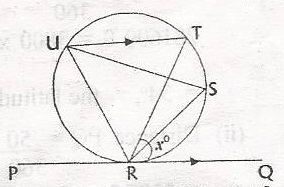
Concept:Use the tangent–chord theorem and the property of parallel lines to find the unknown angle in
△URT.
Explanation:Given:
PQ is a tangent to the circle at
R, and
UT∥PQ.
Also,
∠TRQ=x∘.
By the tangent–chord theorem, the angle between tangent
RQ and chord
RT equals the angle subtended by
RT in the alternate segment.
Therefore,
∠RUT=∠TRQ=x∘.
Since
UT∥PQ, and
RT is a transversal, the alternate interior angles are equal.
Thus,
∠UTR=∠TRQ=x∘.
Now consider
△URT.
The sum of interior angles of a triangle is
180∘.
So,
∠RUT+∠UTR+∠URT=180∘.
Substitute the known angles:
x∘+x∘+∠URT=180∘.
Simplify:
2x∘+∠URT=180∘.
Therefore,
∠URT=180∘−2x∘.
Answer:∠URT=(180−2x)∘ This corresponds to option D.