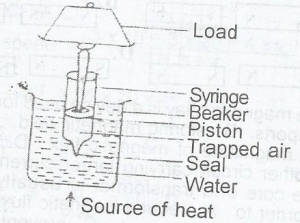
Concept:Heating a gas increases the kinetic energy of its molecules, making them collide with the walls of the container more frequently and with greater force.
Explanation:As the water is heated, heat energy is transferred to the trapped air.
The average speed of the trapped air molecules increases.
These faster molecules now strike the walls of the syringe and the piston more frequently.
More frequent collisions produce a higher pressure inside the syringe.
This increased pressure pushes the piston upward until the pressure inside equals the atmospheric pressure outside.
The number of air molecules and their individual sizes remain unchanged.
Therefore, the rise of the piston is caused by the increased frequency of molecular collisions, not by expansion of individual molecules.
Answer:A. frequency of collision of trapped air molecules with walls of the syringe is more