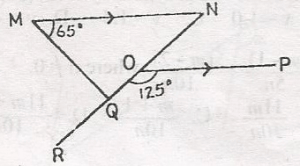
Concept:Apply the properties of parallel lines, the angle sum of a triangle, and supplementary angles on a straight line.
Explanation:On the straight line
ON, the angle
∠QOP=125∘ is given.
So, the adjacent angle is
∠NOP=180∘−125∘=55∘.
Since
MN∥OP and
ON is a transversal, the alternate angles are equal.
Hence,
∠MNO=∠NOP=55∘.
In
△MQN, the angle at
M is
∠QMN=65∘, as shown in the diagram.
Using the triangle angle sum property,
∠QMN+∠MNQ+∠MQN=180∘.
Substitute:
65∘+55∘+∠MQN=180∘.
This gives
∠MQN=180∘−120∘=60∘.
Now,
R,
Q, and
N lie on a straight line, so
∠MQR and
∠MQN are supplementary.
Therefore,
∠MQR+60∘=180∘.
Hence,
∠MQR=180∘−60∘=120∘.
Answer:∠MQR=120∘.
The correct option is
B.