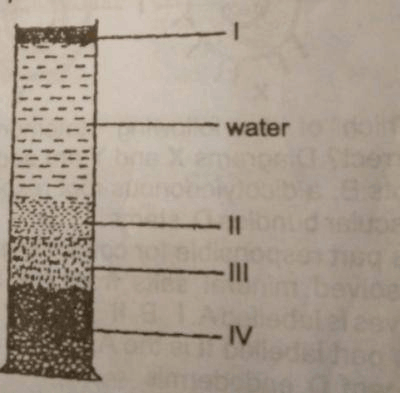
Concept:In soil sedimentation, particles settle in layers according to their densities.
The organic component, often called humus, is the lightest material and therefore floats at the top.
Explanation:When a soil sample is mixed with water and allowed to stand, the mixture separates into distinct layers.
Heavier mineral particles such as sand and gravel sink quickly and settle at the bottom.
Lighter particles like silt and clay form layers above the sand.
The organic component, consisting of decomposed plant and animal matter, remains at the very top because it is lighter than both water and the mineral particles.
In the diagram of the sedimentation experiment, this uppermost organic layer is represented by label I.
The dark, floating material seen on the surface corresponds to this organic component.
Hence, the correct label is I.
Answer:A. I