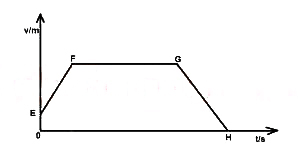
Concept:On a velocity–time (
v–
t) graph, the slope gives acceleration.
A horizontal line means velocity is constant, so acceleration is zero.
Explanation:Between point
F and point
G, the graph is horizontal.
This shows that the velocity of the car does not change during that interval.
Because velocity is constant, the change in velocity is
Δv=0.
Using
a=ΔtΔv, the acceleration becomes
0.
Therefore, the car has no acceleration between
F and
G.
A sloping graph would indicate acceleration or deceleration, but the flat section
FG indicates uniform velocity.
Answer:The car has no acceleration between point
F and point
G.