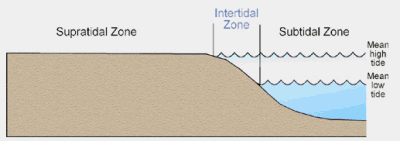
Concept:The intertidal zone is the shore area between the high-tide and low-tide marks, where strong waves force organisms to hold on tightly.
Explanation:Organisms in the intertidal zone experience constant wave action as the tide rises and falls.
They are alternately submerged in seawater and exposed to air, creating stressful conditions.
To avoid being swept away, they develop strong attachment structures such as holdfasts, byssal threads, suckers, or cement-like secretions.
Examples include barnacles, mussels, and seaweeds that cling firmly to rocks.
The supratidal zone is mainly splashed by waves, while the subtidal zone is always underwater, so their organisms face less wave shock.
The abyssal zone is a deep, calm, and dark ocean floor where wave force is absent.
Therefore, the intertidal zone is where attachment adaptation is most essential.
Answer:C. Intertidal