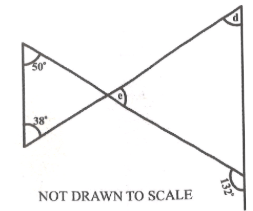
Concept:Use the sum of angles in a triangle (180∘) and angles on a straight line (180∘) to find the unknown angle.Explanation:In △PQR, the given angles are 50∘ and 38∘.Let ∠PRQ=x.Then 50∘+38∘+x=180∘.So x=180∘−88∘=92∘.This angle at R is vertically opposite to the angle marked e, hence e=92∘.On the straight line at T, we have 132∘+∠RTS=180∘.Therefore ∠RTS=180∘−132∘=48∘.In △RST, the three angles are e, d, and ∠RTS.So e+d+∠RTS=180∘.Substitute e=92∘ and ∠RTS=48∘:92∘+d+48∘=180∘.d+140∘=180∘.d=180∘−140∘=40∘.Answer:The angle marked d is 40∘, which is option B.